Over the last five years, coffee consumption has continued to trend upwards, with an “increase of 7.7% from 2015-2020” [1]. Naturally, an increase in demand must see an increase in supply, but what does this mean for farmers, and are they paid fairly? What steps as consumers can we take to ensure farmers are adequately paid?
A Coffee farmer’s wage is dependent on a variety of factors, many of which are uncontrollable, such as supply and demand, weather, pests, and diseases, to name a few. Most coffee is grown at an altitude of 900-1500m; this ensures that “mean temperatures remain in a tight limit” [2]; however, climate change has meant that the lower altitude farms are getting too hot. As a result, growing coffee is becoming harder and less predictable. So, are farmers being paid adequately for their work?
The Fairtrade organisation aims to ensure that coffee farmers are paid adequately for their produce. The current market price of coffee per pound is US$1.76/lb [3], on the 4th August, whereas the “Fairtrade minimum is US$1.40 or US$1.70 for organic coffee, depending on variety” [4] [5], on top of this farmers get paid US$0.20/lb, for Fairtrade premium. Starbucks, between “2012-2014 they reduced the price they pay to coffee brokers from US$2.56/lb to US$1.72/lb, meaning the farmer realistically receives US$1.36/lb” [6].
While the specialty coffee market has seen “growth worldwide, particularly in Europe” [7], they still have similar problems to corporations. Specialty coffee roasters, in general, pay above Fairtrade value for coffee, but this depends on the coffee meeting standards of the roastery/café.
The cost to produce green coffee varies wildly by location and farm. Farms aren’t likely to break even when selling coffee to corporations, as shown in Figure 1 [8]. The coffee supply chain is completely broken, with 20 intermediaries between the farmer and the roaster. The more intermediaries, the less a farmer is paid.
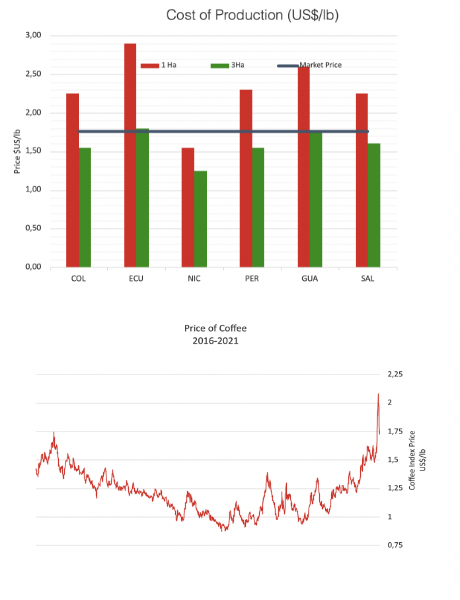
Figure 1: Up – Cost of coffee production [8]. Bottom – Price of coffee from 2016-2021
It’s not all doom and gloom; after all, several specialty roasters are now participating in direct trade, the process where the roaster buys beans straight from the farm. This process can be feasible for companies with the time and money, where it is required to visit farms and speak to trade station representatives. Engrano Coffee is a perfect example of this, and this is what they had to say, “We know exactly how much the coffee farmer receives: the prices he asks for that we transfer directly to his bank account.” [9]
There are inherent risks with direct trade, there is less regulation oversight, payment issues can arise, and the quality of the product may be less consistent. However, the upside is that we see a change in the industry, with more roasters using direct trade.
As coffee becomes harder to grow and the climate becomes less consistent, we must support farms by identifying coffee roasters that contribute the most to farms; by using the following criteria, you can identify where to buy coffee sustainably:
- The roaster performs direct trade, when possible, i.e., Engrano Coffee.
- Ensure that roasters pay a fair wage to farmers; many specialty roasters will be transparent on websites.
- Understand what work is required to produce green coffee and the process it takes to end up in your espresso at a café or a bag sitting on your countertop.
I understand not all roasters have the time or money to direct trade, but the number of intermediaries is decreasing, and there could be a bright future for coffee. However, if we do not fix the supply chain, we may continue to see the decline in coffee farms, causing demand to outweigh supply and prices to soar. Coffee farms should be able to break even and have a living wage greater than US$2 per day.
Bibliography
| [1] | International Coffee Organisation, “Monthly Coffee Market Report,” 6 June 2021. [Online]. Available: https://www.ico.org/documents/cy2020-21/cmr-1020-e.pdf. [Accessed 4 August 2021]. |
| [2] | Kew Gardens, “‘Forgotten’ coffee species that grows at higher temperatures and boasts a superior flavour could help to futureproof the coffee industry under climate change, says new study,” 19 April 2021. [Online]. Available: https://www.kew.org/about-us/press-media/forgotten-coffee-species-futureproofing-industry-against-climate-change. [Accessed 05 August 2021]. |
| [3] | NAsdaq, “Coffee (KT:NMX),” 04 08 2021. [Online]. Available: https://www.nasdaq.com/market-activity/commodities/kt%3Anmx. [Accessed 04 08 2021]. |
| [4] | C. Haight, “The Problem With Fair Trade Coffee,” Stanford Social Innovation Review, 01 July 2011. [Online]. Available: https://ssir.org/articles/entry/the_problem_with_fair_trade_coffee#. [Accessed 05 08 2021]. |
| [5] | Fairtrade, “Fairtrade Minimum Price and Premium Information,” 2021. [Online]. Available: https://www.fairtrade.net/standard/minimum-price-info. [Accessed 08 August 2021]. |
| [6] | D. Cycon, “Paying farmers a living wage is essential to ensuring sustainable coffee production,” GreenBiz, 10 June 2020. [Online]. Available: https://www.greenbiz.com/article/paying-farmers-living-wage-essential-ensuring-sustainable-coffee-production. [Accessed 05 August 2021]. |
| [7] | CBI – Ministry of Foreign Affairs, “European market potential for speciality coffee,” 28 September 2020. [Online]. Available: https://www.cbi.eu/market-information/coffee/specialty-coffee/market-potential. [Accessed 05 August 2021]. |
| [8] | Perfect Daily Grind, “Examining coffee production costs across Latin America,” 30 July 2018. [Online]. Available: https://perfectdailygrind.com/2018/07/this-is-how-much-it-costs-to-produce-coffee-across-latin-america/. [Accessed 05 August 2021]. |
| [9] | Engrano coffee https://www.engrano.nl/ |